See what’s broadcasting around you.
A live radar of the Bluetooth devices broadcasting around you — earbuds, watches, trackers, unknown beacons — identified honestly, with a stated confidence.
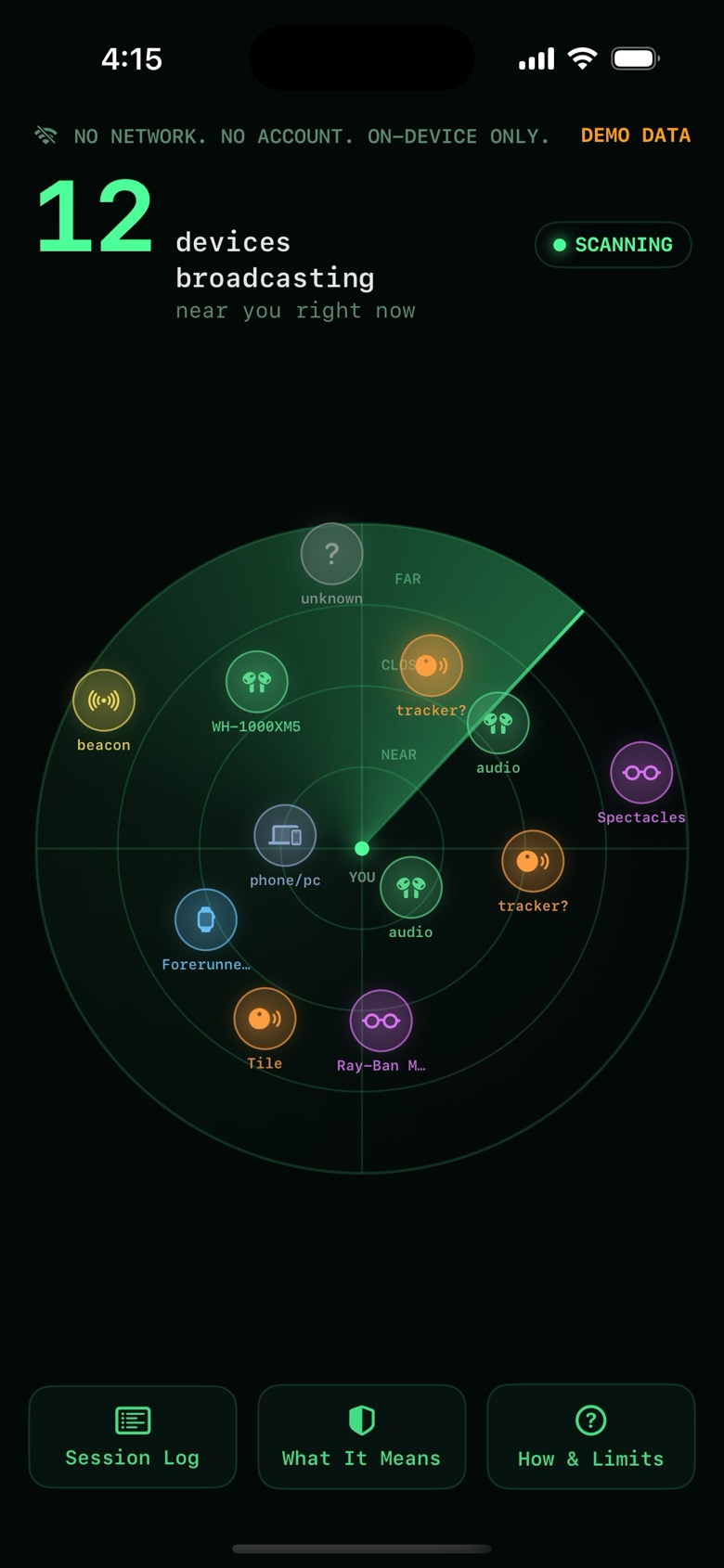
- The radarDevices broadcasting near you right now, plotted by rough distance — Near, Close, Far.
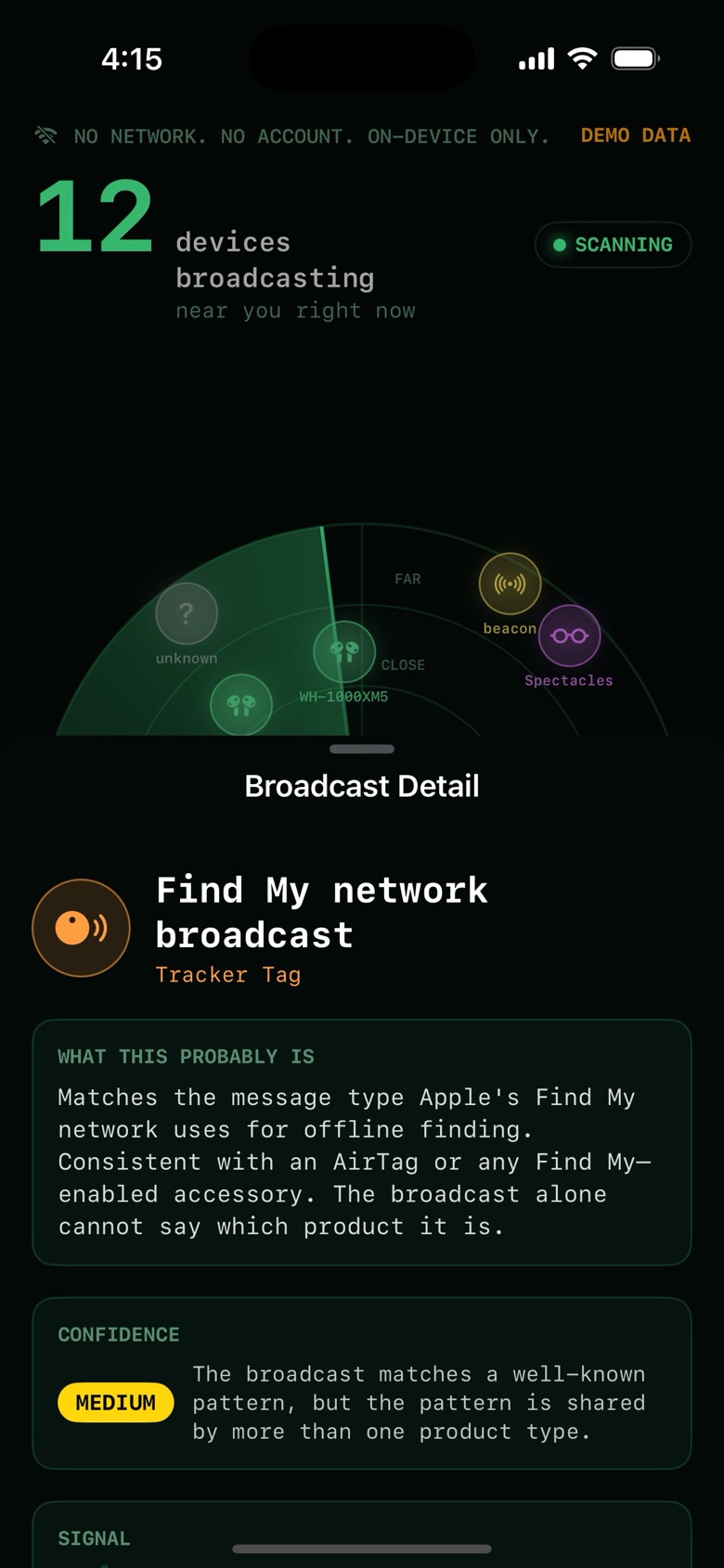
- Broadcast detailTap any blip for what it’s consistent with, a confidence level, and the reason behind it.
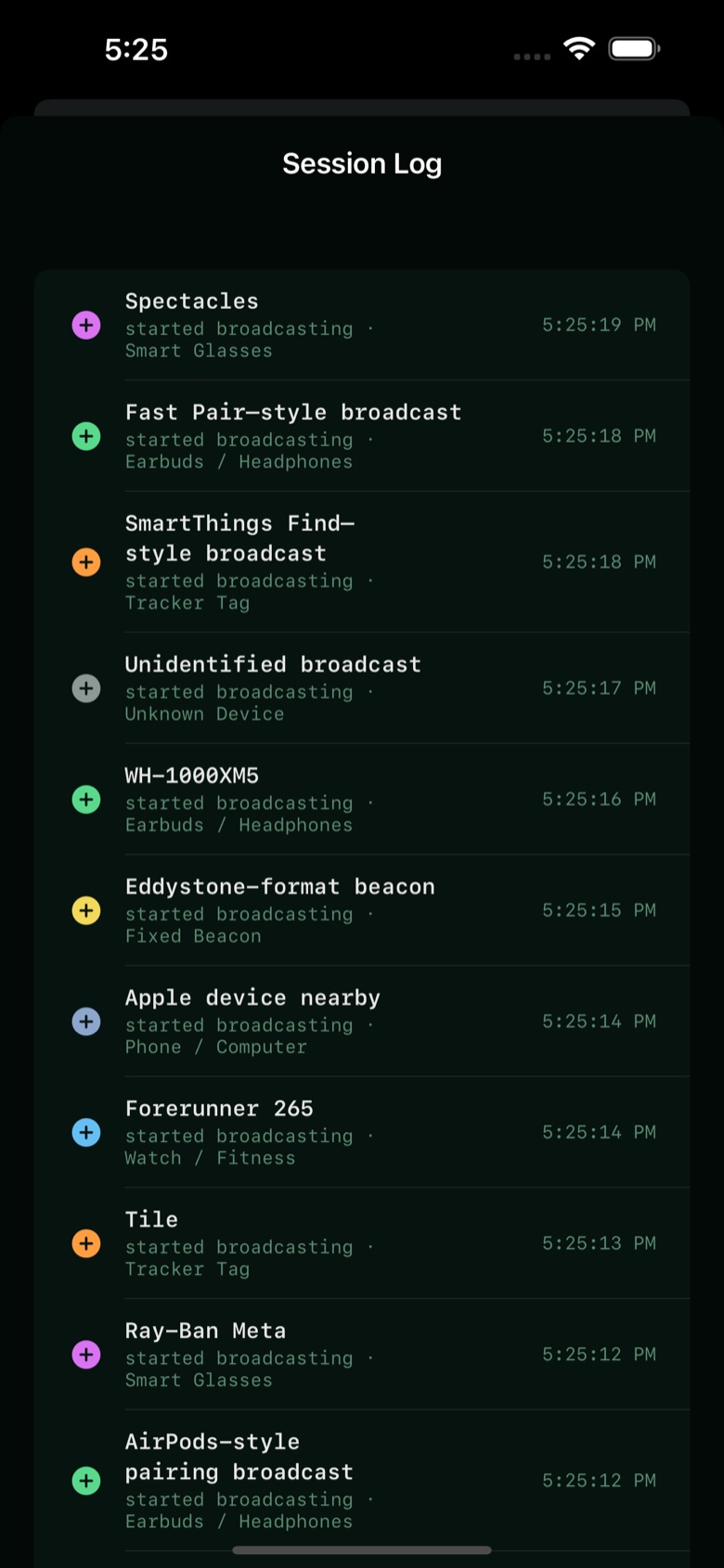
- Session logEvery broadcast that started nearby, timestamped — gone the moment you close the app.
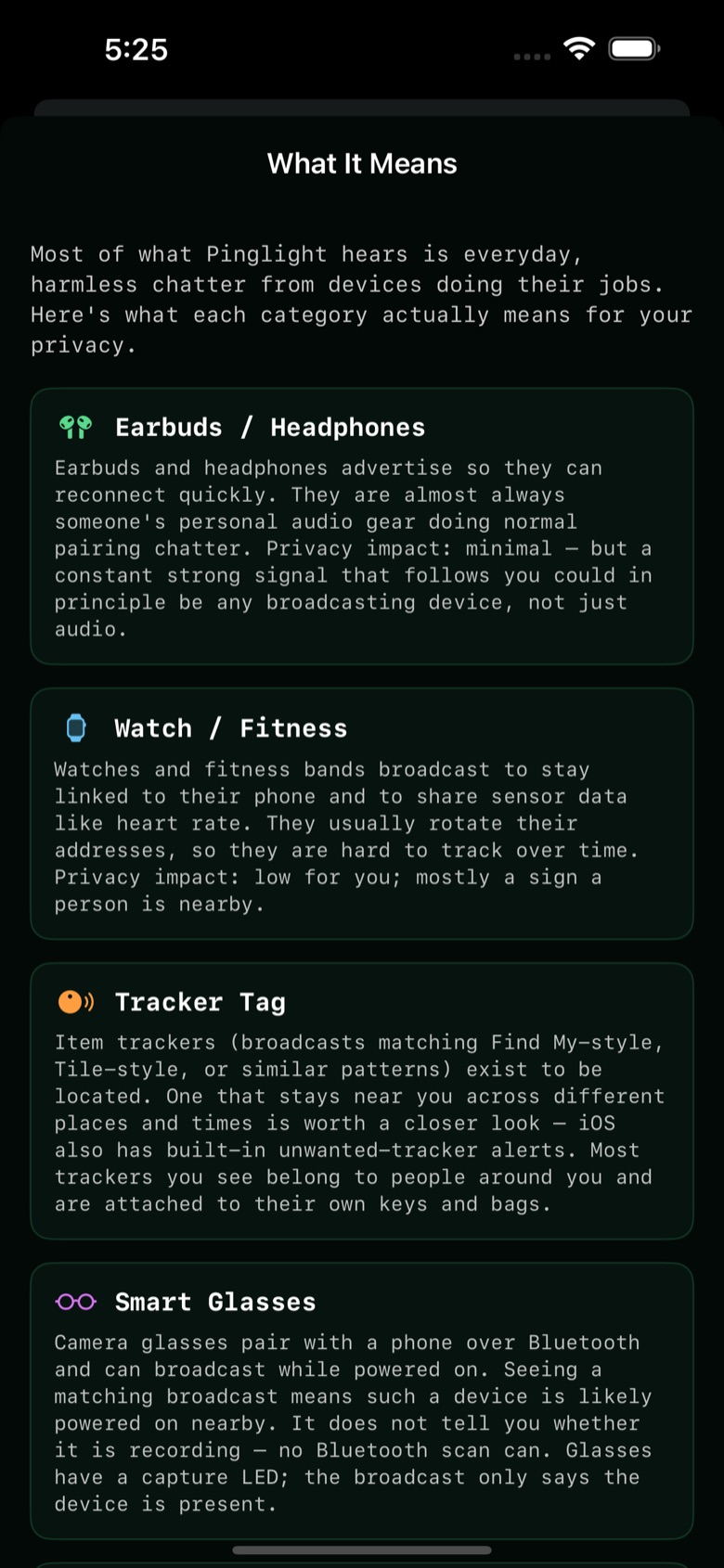
- What it meansPlain-language notes on what each device category actually means for your privacy.
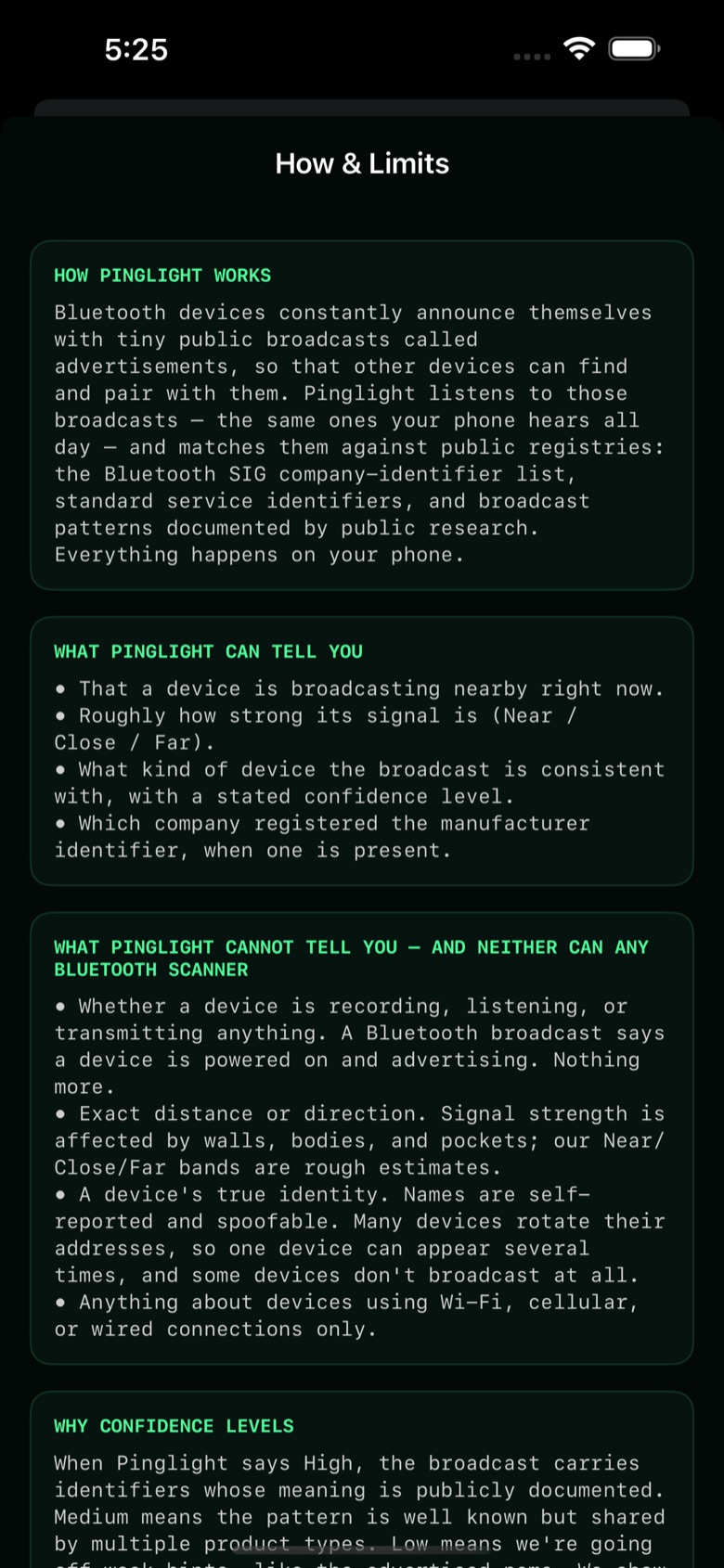
- How & limitsWhat Pinglight can and can’t tell you, spelled out before you rely on it.

 $1.99 until October 31, then $2.99. Every future update included. No ads, no subscription, no account.
- Network calls, anywhere in the app
- 0
- Registered makers, matched on your phone
- 4,009
- Confidence level
- every guess carries one
On the radar
What shows up, and what it usually means.
- Earbuds and headphones
- announce themselves so they can reconnect quickly. Almost always someone's personal audio gear doing normal pairing chatter — and Pinglight says so.
- Watches and fitness bands
- broadcast to stay linked to their phone. Mostly a sign a person is nearby, nothing more.
- Tracker tags
- show up as broadcasts consistent with Find My–style or Tile-style patterns. One that stays near you across different places and times is worth a closer look. Most belong to the people around you.
- Camera glasses
- pair over Bluetooth and can broadcast while powered on. A matching broadcast is consistent with such a device being nearby and switched on — it does not say whether it is recording, and Pinglight tells you that on the same screen. A pair that isn't broadcasting won't appear at all.
- Everything it can't place
- is labeled Unidentified — not dressed up as something scarier. Unknown means unknown.
The limits, up front
No Bluetooth scanner, this one included, can tell you:
- Whether a device is recording, listening, or transmitting.
- A broadcast says a device is powered on and advertising. Nothing more, ever.
- Exact distance or direction.
- Signal strength is bent by walls, bodies, and pockets. Near / Close / Far are rough bands and are labeled as such.
- A device's true identity.
- Names are self-reported and spoofable — a name alone is always marked Low confidence. Many devices rotate addresses; some don't broadcast at all.
- Anything about Wi-Fi, cellular, or wired devices.
- If it isn't broadcasting over Bluetooth, it isn't on the radar.
- That a room is clear.
- An empty radar is not an all-clear. Devices that are off, paired, out of range, behind a wall, or simply not advertising never appear — so a quiet screen proves nothing, and Pinglight is not a sweep.
So Pinglight never says “spy camera detected.” It says what a broadcast is consistent with, and marks every identification High, Medium, or Low — with the reason spelled out. It is an awareness tool for the curious, not a safety or security device: don't rely on it to keep you safe, and don't use it to accuse anyone.
Why no internet?
A privacy tool that phones home isn’t one.
- No network code
- Pinglight has no network code at all — not a setting, an architectural fact.
- How matching works
- Broadcasts are matched against registries built into the app: the Bluetooth SIG's public maker list, standard service identifiers, and broadcast patterns documented by public research. Everything happens on your phone, so nothing you scan can leave it.
- The session log
- Lives in memory and is gone when you close the app. No account, no analytics, no ads — and Pinglight only listens to broadcasts; it never connects to any device.
Get Pinglight.
One payment. Every future update included. No ads, no in-app purchases, no account, no server — the app has no network code at all, and an automated check on every release proves it.